
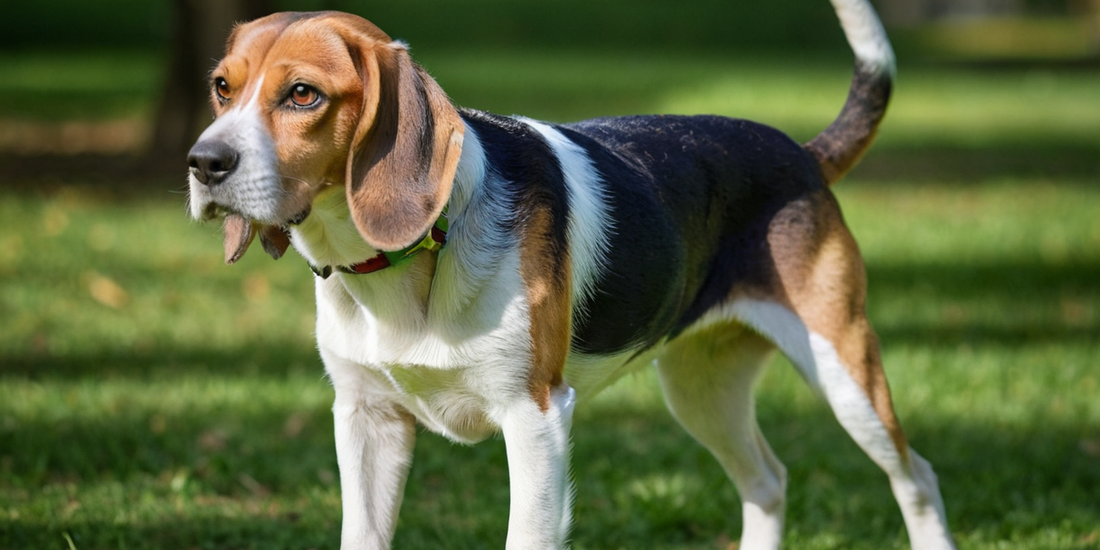
Beagle nutrition is an ongoing topic in every household with this charming pack hound, because hardly any breed loves eating as much as he does. If you have a Beagle, you'll know the devoted look under the dining table, the sniffing out of every crumb in the garden, and his willingness to crawl through three rooms for a scrap of sausage. It's precisely this insatiable appetite that makes feeding your Beagle a particular challenge. It's not about spoiling his enjoyment of food, but about channelling his energy wisely: with high-quality food, clever portion control and treats that taste good without going to his hips.
In this guide, we'll show you what really matters when it comes to Beagle nutrition: which food suits this energetic scent hound, how to prevent excess weight from the start, and which chews you can use to reward him during training without it coming back to haunt you later on the scales.
The Beagle in profile: the dog who's always hungry
Beagles were originally bred as pack hounds for hunting hares and rabbits. They work as a group, follow a trail for hours on end and rely almost entirely on their nose, one of the most sensitive in the entire canine world. This heritage is still present in every Beagle today: he's tireless, agile and constantly on the hunt for new scents, whether that's tracks in the woods or crumbs under the sofa.
This nose is also the reason for the breed's proverbial appetite. A Beagle registers every food source in his surroundings and is barely distracted from it. In the wild, that was a survival advantage; in today's living room, it quickly becomes a problem if food amounts aren't consciously managed. Add to that his pack instinct: Beagles like to eat quickly and in large amounts, because they've learnt through evolution to secure their share within the group before another dog snatches it away. Anyone who understands their Beagle's eating behaviour can counteract it far more effectively when it comes to feeding.
As a typical pack hound, the Beagle is also a decidedly sociable character who needs company, occupation and mental stimulation. Boredom in this breed often shows up exactly where he's most sensitive: at mealtimes. An under-stimulated Beagle begs more, rummages through the bin more often and is more easily talked into extra treats. So giving your Beagle plenty of sniffing games, trail work or seeking games in the garden also takes some pressure off the feeding issue, because his nose gets occupied in a different way than through the bowl.
The right food for your Beagle
An active Beagle needs food that does justice to his love of movement, while not building up a calorie cushion at the same time. The balance between energy and restraint matters more here than with many other breeds. As a small to medium-sized breed, the Beagle also has a comparatively modest energy requirement, one that's quickly exceeded with the wrong feeding, precisely because he's so tireless and trainable at the same time.
High-quality protein as the foundation
A Beagle with plenty of exercise, trail work or dog sport needs enough high-quality protein for muscle building and recovery. Single-protein food with one clearly declared meat source provides exactly these building blocks, without burdening his stomach with unnecessary additives. In our dry food and wet food ranges, you'll find single-protein recipes that let you control precisely which type of meat is on your Beagle's menu, a great advantage if you want to observe how he reacts to particular protein sources.
Grain-free for a stable digestion
Grain-free food is often the better choice for Beagles, because it keeps blood sugar levels steadier than highly grain-based varieties with a high carbohydrate content. That's doubly valuable: it supports settled digestion while also helping to avoid unnecessary calories from cheap fillers, which show up on the scales particularly quickly in this food-loving breed.
Portion control as the most important success factor
When it comes to Beagle food, quantity matters almost as much as quality. Measure the daily ration with kitchen scales rather than by eye, split it into two to three fixed meals, and factor chews and treats into the daily energy allowance right from the start. A food finder can help you work out the right amount and recipe for your dog's weight, age and activity level. Feel free to use our food finder for this, it takes a lot of the calculating off your hands and gives you solid guidance.
Preventing excess weight: the biggest challenge with a Beagle
Hardly any breed is as prone to excess weight as the Beagle. The combination of an enormous appetite, pronounced begging behaviour and the fact that many Beagles get less exercise at home than their hunting instinct actually demands quickly leads to extra kilos. And those extra kilos matter: excess weight puts strain on joints, heart and discs, and can noticeably shorten your dog's life expectancy.
The first step against Beagle obesity is honesty about food amounts. Weigh your dog regularly and feel his ribs, you should be able to feel them with light pressure, without them visibly protruding. If that's not the case, reduce the ration gradually and replace energy-dense extras with lean alternatives. Second, consistent timing helps: fixed feeding times instead of food being constantly available deny the Beagle the chance to eat without restraint. Third, exercise is worth pursuing as an active counterbalance to diet, because a well-exercised Beagle demonstrably begs less and burns off the energy he wants to use anyway.
Very important: the whole family needs to play along too. If every family member secretly slips the Beagle a piece of their dinner, even the best diet is useless. A daily snack limit agreed on together, and followed by everyone, is often more effective than any change of food on its own.
Age also plays a role: as many Beagles grow older, their energy requirement drops noticeably, while their appetite stays just as high. Anyone who doesn't gradually adjust the food amount to their age risks the first excess kilos appearing right around middle age. Regular check-ups at the vet, combined with keeping a watchful eye on weight and condition at home, help you intervene early rather than only reacting once the extra weight is already visible.
Calorie-conscious training treats and chews
Precisely because Beagles are so food-motivated, they're excellent for training, as long as the rewards stay low in calories. Instead of fatty bits of sausage or cheese, it's worth reaching for a lean, natural snack that delivers flavour without blowing the daily balance.
Dried beef is ideal for this: air-dried, single-protein and free from additives, and naturally lean, so you can reward your Beagle frequently during training without immediately adding a whole extra meal. Chicken hearts are another favourite among many Beagles, they're bite-sized, high in protein and portion beautifully, perfect for quick training sessions or as a small reward in between. Horse liver scores points with an intense smell that speaks directly to the nose that defines the Beagle, which makes it a particularly reliable training treat when top motivation is needed, for example during recall training off the lead. For longer chewing sessions, deer skin is excellent: it keeps the Beagle sensibly occupied, challenges his jaw and concentration, and delivers noticeably fewer calories than classic chew bones from the supermarket.
Take your time to browse our chews and treats, all made single-protein, grain-free and without unnecessary additives, so your Beagle gets rewarded without it showing up on the scales. If you're unsure which chew suits your dog's size, chewing style and calorie needs, our chew finder will help you choose.
A practical everyday tip: cut larger snacks such as dried beef or deer skin into small pieces before you start training. This lets you reward your Beagle much more often without blowing the daily ration, while keeping his motivation high throughout the whole training session. Also vary the types of snack, as variety keeps his nose interested and prevents your Beagle from stopping responding to a single reward after a short time.
Allergies and sensitive digestion
Some Beagles react sensitively to certain food ingredients, for example with itching, recurring ear infections or soft stools. Frequent paw licking, a dull coat or changeable stool quality can also point to an intolerance. Since Beagles eat a lot and often anyway, such symptoms frequently go unnoticed for a long time, because they're not obvious at first and are easily mistaken for normal eating behaviour. The most reliable way to pin down a food intolerance is a structured elimination diet: over a set period, you feed exclusively a single protein source that hasn't been used before and observe whether the symptoms improve. Single-protein food is ideal for this, because you know exactly what's in it, with no hidden mixes of several types of meat.
We explain in detail how to carry out an elimination diet with your Beagle properly and step by step on our page about the elimination diet. If symptoms persist, also talk to your vet, so other causes can be ruled out and the dietary change is professionally supervised.
The Beagle puppy
What's best for a Beagle to eat as a puppy? In the first few months, a Beagle puppy grows quickly, but doesn't need an excess of calories for this, since growing too fast puts unnecessary strain on joints and bones. More important is a balanced ratio of high-quality protein, moderate fat content and sufficient nutrients for development, split across several small meals throughout the day, usually three to four at the age of eight to twelve weeks, later reduced to two to three.
With puppies in particular, it's worth developing a good sense of food amounts right from the start, as the habits formed during this phase strongly shape later eating behaviour. Anyone who teaches their puppy early on that not every look automatically means a treat will find it much easier in adulthood to keep the notorious Beagle appetite in check. The same applies to training with a puppy: small, lean snacks in tiny portions are more effective than large reward pieces, because they can be used more often without blowing the daily ration.
Always introduce new food and new snacks to a puppy gradually, so his sensitive stomach can get used to them. A sudden change quickly leads to soft stools in young dogs, regardless of how high-quality the new food is. Mix the new type in with his usual food in increasing amounts over about a week, so his digestion stays stable while you can observe how your puppy reacts to the new recipe at the same time.
Frequently asked questions about Beagle nutrition
Why is my Beagle always hungry?
This is simply in the breed's nature. Beagles were bred as pack hounds for hunting and have learnt to use available food quickly and completely. Combined with their extraordinary nose, this results in a very pronounced appetite that can only be curbed through deliberate feeding routines and fixed amounts.
How much should a Beagle eat daily?
This depends on age, weight and activity level and can't be answered with a blanket rule. The feeding guide on the packaging serves as a guideline, adjusted through regular weighing and feeling his ribs. Our food finder helps you work out a suitable starting amount for your Beagle.
Which chews are suitable for an overweight Beagle?
Lean, single-protein snacks such as dried beef or chicken hearts are a good choice, because they contain little fat and are easy to portion. It's also important to deduct the calories from snacks from his actual food ration, rather than giving them on top.
Can I give my Beagle chews every day?
Yes, as long as you keep an eye on the calories and the chews match your dog's size. Low-calorie options such as deer skin are well suited to regular use, while fattier snacks are better thought of as an occasional treat.
Character & who the Beagle suits
In short, the Beagle is best suited to: active families with patience and scent work.
- Size: medium
- Energy level: active
- With children: very good with children
- Flat living: fine with enough exercise
- For beginners: with a little experience
- Coat care: low maintenance
- Trainability: moderately eager to learn
- Vigilance: not a pronounced watchdog
Not sure whether this breed suits your life? Find out with our breed finder “Which dog breed suits me?”.
Also worth reading: Dog food for allergies





