
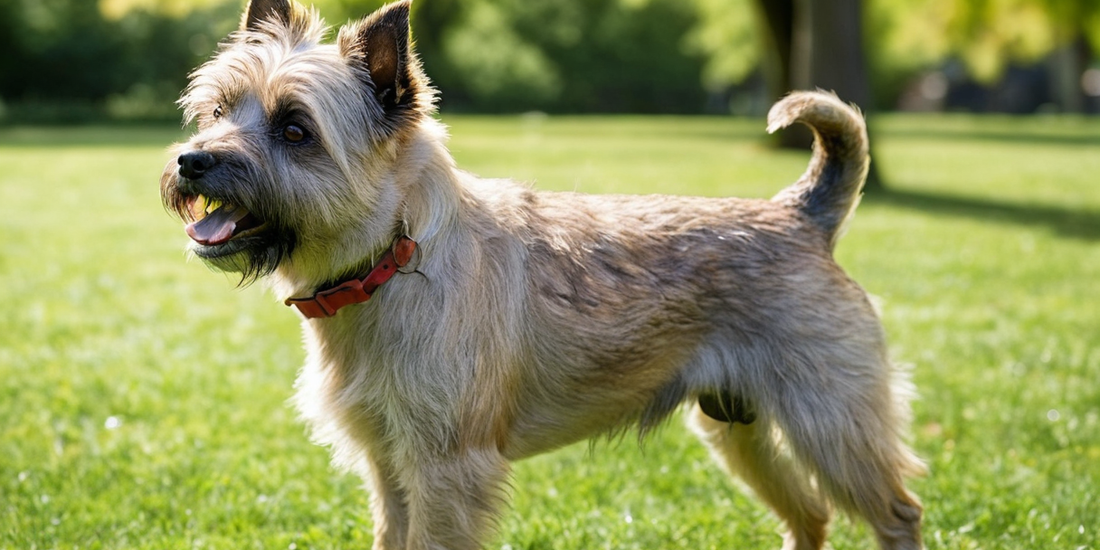
Small, wiry and with a look that knows exactly what it wants: the Cairn Terrier is one of the most popular terrier breeds of all, even though many people do not immediately recognise the name and instead think of "the dog from the Wizard of Oz". As Toto, a Cairn Terrier accompanied Dorothy through Kansas and the Land of Oz, introducing the breed to a wide audience. Behind this adorable film character, however, is a genuine working dog with a mind of its own, bags of energy and a sturdy, weatherproof coat. Whether you are thinking about getting a Cairn Terrier or already share your home with one, here you will find everything important about the temperament, training, grooming and the right diet for this charming small breed.
Profile and Temperament
The Cairn Terrier is one of the small dog breeds, reaching a shoulder height of around 28 to 31 centimetres and weighing between 6 and 7.5 kilograms. Despite its compact size, it is a thoroughly sturdy dog with a solid bone structure, a broad chest and muscular hindquarters that make it an excellent digger and climber. Its coat is harsh, dense and weatherproof, with a soft undercoat beneath. Coat colours range from wheaten through red and grey to almost black, often with a darker mask on the face.
In character, the Cairn Terrier is a real bundle of energy: brave, curious, alert and with a strong will of its own. It is rarely shy, approaches unfamiliar situations with interest rather than caution, and is not remotely intimidated by its small size. Towards its family, it is affectionate, playful and often has a flair for clowning around. With strangers, it is initially reserved and reliably announces visitors with loud barking, making it an attentive little watchdog. Around children, it is usually patient, as long as there is mutual respect on both sides.
If you are interested in this breed because you are still unsure which dog truly suits your everyday life, the kauliebe breed finder offers good guidance for comparing the temperament, size and needs of different breeds.
Origin and History
The Cairn Terrier comes from the Scottish Highlands, more precisely from the area around the Isle of Skye, and is considered one of the oldest terriers of all. Its name derives from the Scottish word "cairn", which refers to the piles of stones marking boundaries and burial mounds, under which rabbits, foxes and other small prey animals often hid. This was exactly where the little terrier was meant to work: it was specifically bred to crawl into these stone piles, track down prey and keep pests away from farm and field.
This work still shapes the Cairn Terrier today. Its compact yet sturdy build, its weatherproof double coat and its fearless nature are a direct legacy of its time as a hunting dog in the harsh Scottish climate. The breed was officially recognised in the early 20th century, long after it had already become firmly established in Scotland. Its international breakthrough finally came in 1939 with the film "The Wizard of Oz", in which the Cairn Terrier Terry played the role of Toto and made the breed world famous. To this day, the breed is often associated with this film character, which does not entirely do justice to its true character as a versatile, sturdy working dog.
Training and Exercise
Anyone taking in a Cairn Terrier should know that small size does not mean low demands here. The Cairn Terrier is an intelligent, independently thinking dog with a strong hunting instinct that needs consistent but loving training. Harsh methods or pressure achieve little with this breed, as it quickly becomes stubborn in response. Training works better through positive reinforcement, clear rules and consistency from the very beginning, combined with plenty of patience and a good sense of humour.
Early socialisation is especially important for Cairn Terriers, as their hunting instinct and curiosity happily lead them exactly where they should not go: into rabbit burrows, under garden fences or chasing after fleeing cats. A reliable recall and lead training are therefore among the most important training goals. At the same time, the breed benefits enormously from mental work: puzzle toys, scent work, search games and small tricks keep the Cairn Terrier's alert mind occupied and prevent boredom, which otherwise quickly shows up as digging in the garden or loud barking.
Physically, too, the Cairn Terrier needs more exercise than its size might suggest. Daily walks, ideally with opportunities to sniff and explore, are just as important as off-lead time in safe areas. Many Cairn Terriers also enjoy dog sports such as agility, mantrailing or earthdog trials, which channel their natural digging and hunting instincts in a positive way. For active families and also for people in the city who regularly set aside time for exercise and enrichment, the Cairn Terrier is a rewarding, entertaining companion.
The Right Diet for the Cairn Terrier
When it comes to diet, the same applies: small, but with high energy needs. The lively, exercise-loving Cairn Terrier needs food that supports its active everyday life with high-quality protein and balanced nutrients, without overfeeding it. As the breed can be prone to putting on weight as soon as it gets less exercise, it is worth keeping an eye on the amount of food given and factoring treats into the daily ration.
For owners who prefer dry food, high-quality, natural dry food with clear meat declaration and no unnecessary additives is a good choice, available through kauliebe's dry food collection. Those who prefer wet food, or like to combine both for variety, will find products with a high meat content in the wet food collection, which appeal even to fussy Cairn Terriers while also ensuring good fluid intake.
Because every dog is different, depending on age, activity level and any sensitivities, it is worth taking a look at the food finder. There, based on breed, size and your Cairn Terrier's individual needs, you can find a suitable food recommendation instead of guessing your way through the range on your own. For such an active and muscular small breed in particular, it makes a noticeable difference whether the food truly matches its actual energy needs.
Chews
Chewing is firmly part of everyday life for the Cairn Terrier: it occupies the mind, burns off excess energy and is good for the teeth as well. As the breed is rather small and compactly built, small but sturdy chews that are matched to jaw size while still lasting long enough for real enrichment are particularly suitable. Chews that are too large or too hard can quickly be too much for small breeds, which is why it is worth paying close attention to size and hardness.
In the natural chews collection, you will find a selection of unprocessed, high-quality chews tailored exactly to this need: purely natural, with no unnecessary additives, and in sizes that are also well suited to smaller breeds such as the Cairn Terrier. For in between meals, as a reward during training, or as a small everyday treat, the natural treats collection is also a great option, ideal for giving the eager-to-learn Cairn Terrier positive reinforcement without throwing its daily ration off balance.
If you are unsure which chew really suits your Cairn Terrier's size, enthusiasm for chewing and any preferences, the chew finder can help. It takes factors such as breed size and chewing intensity into account and suggests suitable products, so that you do not risk choosing chews that are either too unchallenging or unsuitably hard.
Coat Care and Health
The Cairn Terrier's harsh, wiry coat is weatherproof and practical by nature, but still needs regular care to keep its function and appearance. Unlike many other breeds, the Cairn Terrier's coat should not be clipped but hand-stripped, meaning dead hairs are plucked out rather than cut. If the coat is regularly clipped instead, it gradually loses its harsh texture, becomes softer and thinner, and loses its weather protection. A stripping session two to three times a year, depending on coat growth, keeps the top coat in shape and also means fewer loose hairs end up around the house.
Between stripping sessions, weekly brushing is usually enough to prevent matting, especially behind the ears, on the legs and on the belly. After walks through undergrowth or fields, it is also worth doing a quick check for grass seeds, ticks and small injuries to the paws, as the Cairn Terrier's urge to dig and explore often takes it roaming through dense scrub.
Health-wise, the Cairn Terrier is considered a robust, long-lived breed with a life expectancy often of 13 to 15 years. Like many small terrier breeds, however, it can be prone to certain hereditary conditions, including patellar luxation, certain eye diseases and so-called craniomandibular osteopathy, a bone condition that occurs at a young age. Reputable breeders usually have the parent animals screened accordingly, which significantly lowers the risk. Regular check-ups at the vet, sufficient exercise and a diet tailored to its needs also help keep the Cairn Terrier fit and healthy for a long time.
Frequently Asked Questions
How much exercise does a Cairn Terrier need each day?
Despite its small size, the Cairn Terrier is an active dog and should get at least one to two decent walks every day, supplemented with enrichment such as scent work, search games or short training sessions. Short, trotting laps around the block are not enough in the long run to keep this breed physically and mentally satisfied.
Is the Cairn Terrier suitable for beginners?
A Cairn Terrier suits people who are willing to engage intensively with training and enrichment, as its independent character and hunting instinct call for consistency. Anyone who is prepared to commit and invest the time can certainly get on well with a Cairn Terrier even as a first-time dog owner.
Does the Cairn Terrier get on with cats and other pets?
This depends heavily on individual socialisation. If a Cairn Terrier grows up with cats or other animals from an early age, relaxed cohabitation can work well. With unfamiliar small animals such as rabbits or rodents, however, the breed's original hunting instinct can break through at any time, so caution is advisable.
How often does a Cairn Terrier's coat need to be stripped?
Professional stripping of the coat usually makes sense two to three times a year, depending on individual coat growth. Weekly brushing between sessions also keeps the coat free of matting and helps preserve its typical harsh, weatherproof texture.
Character & Who the Cairn Terrier Suits
In short, the Cairn Terrier is the best fit for: active families and city dwellers who like a sturdy little terrier.
- Size: small
- Energy level: active
- With children: very good with children
- Living situation: suitable for flats
- For beginners: with some experience
- Coat care: medium grooming effort
- Trainability: moderately eager to learn
- Alertness: watchful
Not sure whether this breed suits your life? Find out with our breed finder "Which dog breed suits me?".
Also worth a look: Natural Chews





