
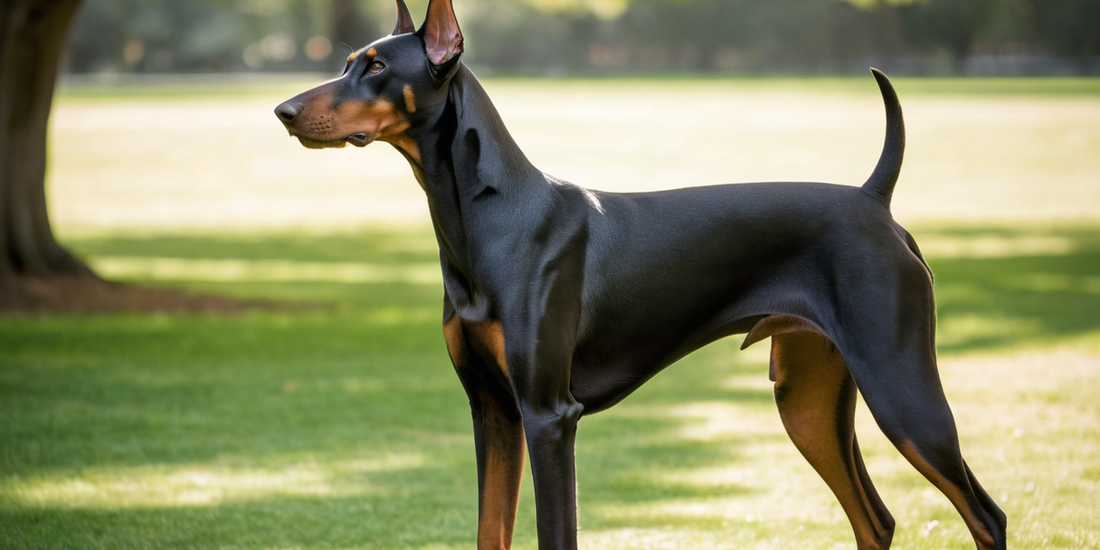
The Dobermann is one of the most elegant and, at the same time, most versatile working dogs there is. Slim, muscular and with an alert expression, he appears imposing at first glance, yet at heart he's a highly sensitive, deeply loyal family dog who seeks a close bond with his people. Anyone who chooses a Dobermann is bringing home an intelligent thinker who needs tasks, appreciates clear leadership and, with fair, consistent training, becomes an exceptionally reliable companion. In this guide, you'll learn what defines the Dobermann's character, where the breed comes from, how training and exercise succeed, and what to look out for especially regarding diet and health.
Profile and temperament
The Dobermann is a medium to large dog with strong, sinewy muscles under a short, low-maintenance coat. Males reach a shoulder height of around 68 to 72 centimetres, with females slightly smaller. Typical features include the black or brown base colour with rust-red markings, an upright posture and a focused, alert expression. Visually, the Dobermann radiates strength and control, and that's exactly what his character reflects too.
In temperament, the Dobermann is highly intelligent, eager to learn and extremely loyal. He forms a close bond with his primary carer and would ideally like to be involved in everything. He's reserved to watchful towards strangers, never aggressive without reason, provided he's well socialised and well led. This exact combination of protective instinct, obedience and emotional closeness makes him one of the most reliable guard and protection dogs around, but at the same time also a dog for whom leadership can never be an afterthought. A Dobermann suits experienced, sporty people best, who handle him consistently, calmly and fairly and offer him enough mental and physical work. The breed tends to be unsuitable for unsure first-time owners or pure sofa enthusiasts. If you're unsure whether the Dobermann really suits your everyday life, our breed finder can help you honestly check whether temperament, exercise needs and your lifestyle match up.
Origin and history
The breed owes its name to the tax collector Karl Friedrich Louis Dobermann from Apolda in Thuringia. At the end of the 19th century, he often travelled with large sums of cash and needed a dog that would protect him reliably while remaining obedient and controllable. To achieve this, Dobermann crossed various breeds common at the time, including early shepherd dog lines, Rottweiler ancestors and Pinschers, to produce an alert, brave yet controllable companion dog. After his death, the breeder Otto Goeller continued the work, refined the appearance and established a consistent breed description, which also gave the dog its current name.
Over the decades, the robust working dog for personal protection developed into a versatile working breed, now used in service dog roles, search and rescue, dog sports, and as an attentive family dog. The FCI places the Dobermann in Group 2, alongside Pinschers and Schnauzers, Molossoid breeds and Swiss Mountain Dogs. Despite his breeding history as a protection dog, the modern Dobermann is no fighting dog, but a highly intelligent working partner who needs mental stimulation just as much as sufficient exercise.
Training, bonding and exercise
A Dobermann learns fast, and that's both an opportunity and a challenge at the same time. He usually picks up commands after just a few repetitions, but equally quickly tests where the boundaries lie and whether you'll stay consistent today too. Training should therefore begin early, be clear and avoid harshness. Careful socialisation as a puppy, positive reinforcement through praise, play and treats, and a calm, confident attitude on your part as his carer are all essential. Shouting or pressure achieve little with this sensitive breed, whereas clear structure and reliability achieve a great deal.
Because the Dobermann was originally bred as a protection dog, a firm emotional bond with his family is deeply rooted in him. He wants to be challenged not only physically but mentally too. Classic obedience training, scent work, retrieving games, agility or guided dog sports such as obedience trials and tracking suit his nature excellently. Long runs, bike rides or hikes are also welcome, as the Dobermann is an enduring athlete with a strong urge to move. For training on the go, small, high-quality rewards from our natural treats are particularly suitable, as they can be fed quickly and won't interrupt the flow of training.
If a Dobermann is under-stimulated, this quickly shows up as restlessness, excessive barking or destructive behaviour. A well-exercised Dobermann, on the other hand, is a calm, balanced and remarkably reliable housemate, who settles down happily at home once his mind and body have had enough to do.
The right diet for the Dobermann
As a muscular, athletic dog, the Dobermann has a noticeably higher need for high-quality animal protein than smaller or calmer breeds. His musculature needs to be maintained and nourished, while his metabolism needs sufficient energy for training and everyday life. The quality of the protein source matters here: high-quality muscle meat, digestible offal and a well-balanced fat-to-protein ratio provide considerably more benefit than cheap fillers. Our dry food and wet food ranges are designed with high meat content and easily digestible recipes, and can be combined depending on your Dobermann's activity level.
When it comes to portioning, it's worth paying close attention. Especially during puppyhood and adolescence, the Dobermann grows tall quickly, and growing too fast through overfeeding or an incorrect energy ratio can place unnecessary strain on joints and skeleton. Adult Dobermanns, on the other hand, benefit from a portion size tailored to their weight and training load, split across two meals a day. This takes the strain off the stomach and helps prevent bloating as well as gastric torsion, to which large, deep-chested breeds like the Dobermann are generally more prone. If you're unsure which food best suits your dog's age, weight and activity level, our food finder guides you step by step to the right recommendation.
Some Dobermanns also respond with a sensitive stomach to frequent food changes or hard-to-digest ingredients. Consistent, high-quality feeding with clearly declared ingredients helps avoid digestive problems. One topic that deserves particular attention in this breed is dilated cardiomyopathy, or DCM, a heart muscle condition to which the Dobermann is genetically more predisposed than many other breeds. In recent years, there has also been discussion as to whether certain heavily grain-free, legume-rich food recipes can affect taurine and L-carnitine levels and thereby indirectly affect heart health. A balanced, nutrient-rich food with high-quality protein sources is therefore not a minor detail, but an important part of preventive health care. If you have any concerns or specific dietary needs, always speak to your vet, particularly if your Dobermann has already had a cardiac examination.
Robust chews and treats
With his strong jaw and pronounced need to chew, the Dobermann needs chews that can really take a beating. Soft or thin snacks are usually gone within a few minutes and provide little in the way of occupation. Robust, natural chews, on the other hand, challenge the jaw and concentration over a longer period, help clean the teeth along the way, and provide the relaxing follow-up activity that many Dobermanns need after training or a long walk. In our natural chews, you'll find strong, long-lasting chews that live up to this athletic breed's demands.
When choosing, pay attention to the right size and hardness for a powerful chewer, and watch your dog while he's chewing, especially with new items. For the Dobermann, chewing isn't just an activity, but also an outlet that relieves stress and brings calmer moments into everyday life. Because individual preferences and chewing intensity vary from dog to dog, our chew finder helps you filter out exactly the items that suit your Dobermann's size, chewing strength and dental health from the wide range available.
Health and grooming
The Dobermann's short, dense coat is low-maintenance: occasional brushing is usually enough to remove loose hairs and keep the coat glossy. Because his thin coat and low body fat offer little insulation, a Dobermann feels the cold and wet faster than more robust breeds. A dog coat for winter isn't a fashion statement for this breed, but genuine protection against the cold.
Health-wise, the dilated cardiomyopathy already mentioned deserves particular attention. In DCM, the heart muscle weakens and the heart enlarges, which, if left untreated, can lead to cardiac arrhythmia or heart failure. As the condition often progresses without visible symptoms at first, cardiologists recommend regular preventive check-ups for the Dobermann using cardiac ultrasound and long-term ECG, usually from around three to four years of age, or earlier depending on family history. Watch out for warning signs such as tiring more quickly, coughing without an obvious cause, or breathlessness during exertion in everyday life, and discuss these observations openly with your vet practice.
Other issues that can play a role in the Dobermann include von Willebrand disease, an inherited blood clotting disorder, and, to a lesser extent, hip dysplasia. A reputable breeder tests breeding animals accordingly and can tell you about the health history of the parent dogs. In Germany, cropping the ears and docking the tail is banned on animal welfare grounds, which is why the modern German Dobermann appears with natural drop ears and a full tail, an appearance that does nothing to detract from his elegant, athletic build.
Frequently asked questions
Is the Dobermann suitable for beginners?
Not without reservation. The Dobermann is intelligent, sensitive and needs clear, fair and consistent leadership from the start. Experienced, sporty owners who have time for training, exercise and socialisation cope considerably better with this breed than absolute first-time dog owners.
How much exercise and stimulation does a Dobermann need?
An adult Dobermann needs several hours of exercise every day, along with regular mental stimulation through training, dog sports or scent work. Walks alone generally aren't enough to truly satisfy this breed.
What should I watch out for regarding my Dobermann's heart health?
Have your Dobermann's heart checked regularly by a vet, ideally from the third or fourth year of life, as DCM occurs more frequently in this breed. Also pay attention to a balanced, high-quality diet and discuss any dietary questions openly with your vet practice.
Is the Dobermann still cropped and docked in Germany?
No. Cropping the ears and docking the tail is banned by law in Germany on animal welfare grounds. German Dobermanns therefore have natural drop ears and the full length of their tail.
Character & who the Dobermann suits
In short, the Dobermann is best suited to: experienced, sporty owners who want to lead a watchful companion.
- Size: large
- Energy level: active
- With children: good with children
- Flat living: rather unsuited to flat living
- For beginners: rather for experienced owners
- Coat care: low-maintenance
- Trainability: very eager to learn
- Alertness: pronounced watchdog
Not sure whether this breed suits your life? Find out with our breed finder "Which dog breed suits me?".
Goes well with: Natural treats for dogs





