
When a Rhodesian Ridgeback moves in with you, you are bringing home one of the strongest and most enduring dogs there is. This is precisely why Rhodesian Ridgeback nutrition deserves special attention: a dog that originally tracked lions and could keep up a full pace for hours needs food that does justice to his muscles, his joints and his energy balance. In this guide, you will find out what really matters when it comes to food for the Rhodesian Ridgeback, which chews suit his powerful jaw, and how to support him in good health through everyday life, from puppy to senior.
The Rhodesian Ridgeback in profile: an athletic endurance dog
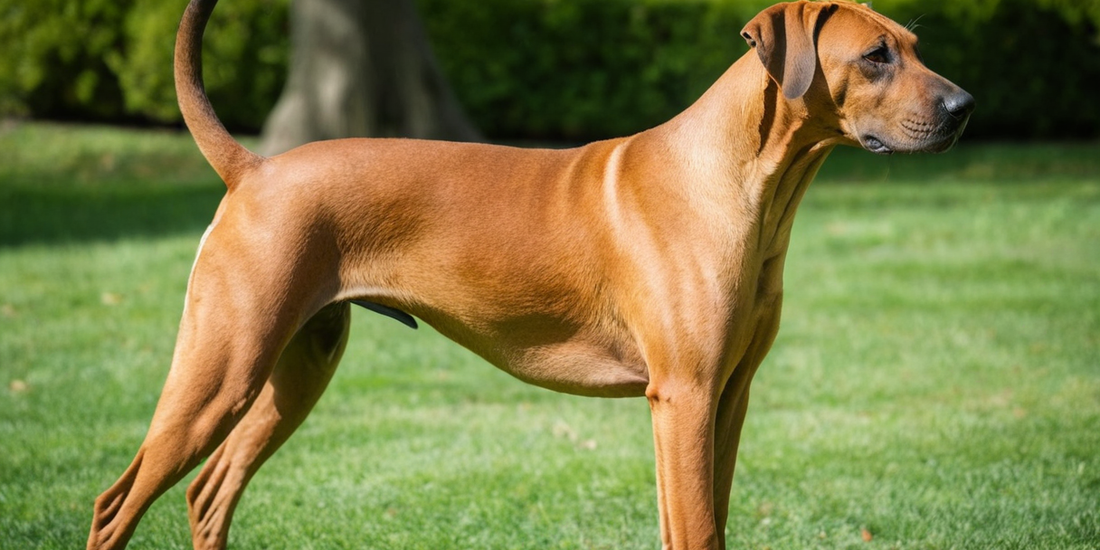
The Rhodesian Ridgeback comes from southern Africa, where he was once used to hunt big game, including lions. His name comes from the characteristic ridge of hair along his spine, which grows against the direction of the rest of the coat. Visually, his athletic, lean and muscular build stands out immediately: long legs, a deep chest and taut muscles that look as though there is not an ounce to spare. Adult males weigh around 36 to 41 kilograms, females around 32 kilograms, each with a shoulder height of 61 to 69 centimetres.
This combination of size and athleticism makes the Ridgeback a true endurance machine. He can maintain a high pace over long distances, yet remains remarkably undemanding and calm in temperament. Anyone wondering what a Rhodesian Ridgeback eats best therefore needs to think about two seemingly contradictory traits together: the high energy needs of an endurance athlete and the modest requirements of a robust, primitive breed. This is exactly where thoughtful feeding comes in.
In character, too, the Ridgeback has remained an original: independent, self-assured and strong-willed, yet at the same time very people-oriented and loyal. This independence also shows up in his eating behaviour, as many Ridgebacks are picky and will not be satisfied with just any food. A high-quality food that is genuinely appealing in taste therefore pays off twice over with this breed: it covers his high nutrient needs and is still reliably eaten.
The right food for a powerful athlete
A Rhodesian Ridgeback carries a lot of muscle mass on a large frame, and that muscle needs to be maintained and supplied. Rhodesian Ridgeback food should therefore be rich in high-quality animal protein, since amino acids from genuine meat are the building blocks for muscles, tendons and a functioning immune system. At the same time, the food should be energy-dense enough to cover the breed's need for exercise without you having to feed huge quantities, which would in turn put a strain on the digestive tract.
Alongside protein content, it is worth looking at fat quality. High-quality, natural fats provide concentrated energy for long runs and at the same time support a glossy coat and an intact skin barrier, which is particularly noticeable in Ridgebacks with their short, dense coat. It is also important that the recipe does without unnecessary additives, artificial flavourings or preservatives, because the more natural the composition, the easier it is to assess the dog's digestion and adjust it specifically if needed.
Feeding single-protein and grain-free
Many Ridgeback owners report that their dog reacts sensitively to individual protein sources or to grain, with itching, soft stools or an unsettled stomach. A single-protein food with just one type of meat helps you understand exactly what goes into the bowl, and makes feeding easier to track if an elimination diet is ever needed. Grain-free recipes also ease the burden on digestion, drawing energy instead from easily digestible, natural carbohydrate sources.
In the dry food range, you will find single-protein, grain-free recipes with a high meat content, tailored exactly to this need. For days with particularly high levels of exercise, or for Ridgebacks who like to take in more moisture through their food, wet food is also suitable as a supplement or alternative. If you are unsure which variety suits your dog, the food finder can help you find the right recipe in just a few steps.
Muscles & joints: protecting a large, active breed
Large, heavy breeds with a strong need for exercise carry an increased risk of joint problems, and the Rhodesian Ridgeback is no exception. His athletic build means that his hips, elbows and spine have to absorb a considerable amount of strain over the years, especially when sprinting, braking abruptly or jumping. Rhodesian Ridgeback joints therefore benefit from a food that actively supports the musculoskeletal system, rather than simply providing nutrients as a side effect.
A balanced calcium-to-phosphorus ratio is also important, especially during the growth phase, along with a fat content that leads neither to excess weight nor to a nutrient deficiency. Growing too fast or carrying too much weight on young joints can later show up as hip dysplasia or elbow problems, so it is worth planning feeding carefully from the start and regularly checking whether weight and condition still match the dog's activity level.
Joints also remain a relevant topic in adulthood, as Ridgebacks are often still very keen on exercise well into old age and want to keep running, jumping and playing along. Balanced nutrition throughout the dog's entire life, combined with appropriately adjusted exercise rather than one-sided extreme exertion, helps maintain mobility for as long as possible. Especially with young, still-growing Ridgebacks, make sure to avoid excessive stair climbing, long jumps out of the boot, or hours of ball games, even if the dog himself never seems to get enough of it.
Robust chews for strong chewers
The Rhodesian Ridgeback has a powerful, well-developed set of teeth and a pronounced urge to chew. Soft or thin snacks are often gone within seconds for him and offer neither enrichment nor real dental care. Ridgeback chews should therefore be robust, long-fibred and single-protein, so they can withstand his powerful jaw while also providing worthwhile enrichment for a long time.
Beef Achilles tendons, for example, are well suited: natural, air-dried and pleasantly long-fibred, so your Ridgeback can work on them for a long time. Buffalo tracheas are also popular with powerful chewers, as they are especially tough and hold up well even to intensive chewing. Anyone looking for a particularly long-lasting chew will find a robust companion for extended chewing sessions in buffalo skin, for example as a mega plait or in natural form. The entire chews range is air-dried and free from additives, designed specifically for dogs who take chewing seriously. You will also find a dedicated category of particularly robust buffalo chews in the shop. If you are unsure which chew matches your dog's chewing strength, the chew finder can help you choose.
Weight & an active everyday life
Despite his athletic appearance, the Rhodesian Ridgeback can certainly tend towards being overweight with too little exercise or overly generous feeding, and every excess kilogram places additional strain on joints and circulation. How much food your dog needs depends heavily on how active his everyday life actually is: a Ridgeback who goes on long runs or cycling trips every day burns considerably more energy than a more sedentary family dog of the same breed.
It is worth adjusting the amount of food not rigidly by a chart, but according to your dog's actual appearance. As a rule of thumb: viewed from above, a slight waist should be visible, and the ribs should be easy to feel with light pressure, but not visible. Regular weighing and a watchful eye on condition help you step in early, before a few extra kilograms turn into a lasting problem.
Especially during quieter phases of life, for example after an injury, in winter with shorter walks or in old age, energy needs drop noticeably, even though appetite often stays just as strong. Reduce the amount of food deliberately during such phases and split larger portions over two meals rather than feeding a large amount once a day. This not only eases digestion but also helps reduce the risk of bloat in deep-chested breeds like the Ridgeback.
Allergies & sensitive digestion
Like many robust, primitive breeds, the Rhodesian Ridgeback can also react sensitively to certain food components. Typical signs include recurring itching, ear infections, soft stools or excessive flatulence. Before trying out various types of food at random, a structured elimination diet can help narrow down the cause: for a set period, you feed only a single protein source that the dog has not previously eaten, and observe whether the symptoms improve.
Single-protein feeding, as offered by many kauliebe recipes, makes this process much easier, because you always know exactly which ingredient was in the bowl. You will find detailed guidance on the correct approach on our page about the elimination diet. If symptoms persist or are severe, you should also seek veterinary advice, as not every intolerance can be resolved through food alone.
Patience is also important: an elimination diet usually only shows reliable results after several weeks, because the skin and digestion only adjust gradually. During this time, it is best to note down which food and which chews you have given and how your Ridgeback has responded. This way, if you ever change his food again later, you will quickly recognise whether a new ingredient is well tolerated or not.
The Ridgeback puppy: controlled growth
Rhodesian Ridgeback puppies grow into large, heavy dogs in a short space of time, and this rapid growth is precisely the most sensitive phase for bones and joints. A food that is too energy-rich may make the puppy grow quickly, but it increases the risk of developmental problems in the hips and elbows. The goal is therefore controlled, even growth rather than the fastest growth possible.
A puppy food specifically formulated for large breeds, with a balanced calcium-to-phosphorus ratio and a moderate fat content, supports exactly this process. Exercise is just as important as food: young Ridgebacks should avoid long jumps, extended sprints and hard stops on hard ground in the first few months, so the still-open growth plates are not overloaded. Short, calm walks with plenty of sniffing time are more valuable for the puppy than long, exhausting outings.
The same applies to chewing for puppies: less hardness, more variety. Milk teeth and the growing jaw cannot yet cope with very hard chews, which is why shorter, thinner versions of the air-dried natural chews are more suitable during this phase, still providing enrichment without overtaxing the young teeth. Only once the full tooth change is complete and the jaw is more stable should you gradually move on to the more robust chews meant for adult Ridgebacks.
Frequently asked questions about the Rhodesian Ridgeback
How much food does a Rhodesian Ridgeback need per day?
This depends on weight, age and above all on daily activity. A very active, fully grown Ridgeback needs considerably more energy than a sedentary dog of the same size. Use the feeding recommendation on the packaging as a guide, but adjust the amount regularly based on body condition.
Is grain-free food a good idea for the Rhodesian Ridgeback?
Yes, particularly because Ridgebacks are more prone to sensitive digestion or food intolerances. Grain-free, single-protein recipes are usually easier to digest and make it easier to narrow down possible triggers of intolerance.
Which chews are suitable for a strong chewer like the Ridgeback?
Robust, natural chews such as beef Achilles tendons, buffalo tracheas or buffalo skin stand up to his powerful jaw and keep your dog meaningfully occupied for an extended period.
What should I particularly watch out for during puppy growth?
Controlled, not overly fast growth, a food for large breeds with a balanced mineral ratio, and gentle exercise without hard jumps or long sprints, until the growth plates have closed.
Character & who the Rhodesian Ridgeback suits
In short, the Rhodesian Ridgeback is best suited to: active, experienced owners, an independent athlete.
- Size: large
- Energy level: active
- With children: good with children
- Flat living: rather unsuitable for flats
- For beginners: rather for experienced owners
- Coat care: low-maintenance
- Trainability: eager to learn
- Watchfulness: strong watchdog instinct
Not sure whether this breed suits your life? Find out with our breed finder “Which dog breed suits me?”.
Also relevant: Dog food for allergies





