
An adult dog from around 12 months has different dietary needs to a puppy, and a senior from 7 to 8 years has different needs again. Understanding this helps you make better decisions: on protein, on portion size, on switching to senior food, and on how to recognise allergies and digestive problems before they become chronic. This guide gives you the factual foundation for that.
🐾 Which food suits your dog?
Our food finder identifies the right NANDOO variety in just a few clicks, matched to your dog's age, weight and tolerance.
Go to the food finder → Free & no obligation, takes less than 2 minutesAdult dog or senior, what's the difference?
The transition from puppy to adult dog, and later to senior, is gradual and breed-specific. As a rule of thumb:
- Small breeds (under 10 kg): adult from around 10 to 12 months, senior from around 10 to 12 years
- Medium breeds (10 to 25 kg): adult from around 12 to 15 months, senior from around 8 to 9 years
- Large breeds (25 to 45 kg): adult from around 18 months, senior from around 7 years
- Giant breeds (over 45 kg): adult from around 24 months, senior from around 5 to 6 years
What changes at the transition to senior status is not the basic principle of nutrition, it's the energy needs, digestive performance, joint load and the need for certain nutrients such as protein and omega-3 that change. A dog put on the same food at 7 years old as at 3 years old, and who gains weight as a result, is simply getting too much energy for its changed metabolism.
Key point: Senior doesn't mean ill, it means changed. Adjusting the food to the new life stage is prevention, not treatment.
Energy needs of adult dogs: what really matters
The energy needs of an adult dog are not a fixed value. They depend on body weight, activity, neuter status, muscle mass, temperament and environment. A dog that runs for a long time and exercises daily uses noticeably more energy than a dog that mostly goes on leisurely walks, even at the same weight.
Neutered dogs typically have an energy requirement around 20 to 30% lower than intact dogs, because the hormone balance affects the basal metabolic rate. This is often underestimated: many dogs put on weight after neutering because the portion size wasn't adjusted.
The concept that really helps is energy density: kilocalories per 100 g of food. Dry food typically provides 330 to 420 kcal per 100 g, wet food 70 to 100 kcal per 100 g. Small amounts of dry food can already provide a lot of energy. Anyone who thinks only in grams and not in calories can easily overfeed.
Two checkpoints for everyday use: body weight (the objective figure) and body condition (the interpretation). The ribs should be easily felt but not visible, the waist visible from above, the belly slightly tucked up. If you're unsure, ask your vet.
Energy needs in seniors: fewer calories, more protein
In older dogs, energy needs decrease, but protein needs don't. That sounds contradictory at first, but it's explained by physiology: with age, the body breaks down muscle mass faster than in younger years (sarcopenia). To counteract this, the body needs more protein, not less, as a building block for maintaining muscle.
Older guides recommended protein-reduced food for senior dogs to protect the kidneys. This approach is now considered outdated for healthy dogs without a diagnosed kidney condition. Current veterinary recommendations (including WSAVA Small Animal Clinical Nutrition) see no reason for protein reduction in healthy seniors, quite the opposite.
- Less total energy, because activity decreases and the basal metabolic rate falls
- The same or higher protein content, for muscle maintenance
- More omega-3 fatty acids, for joints, anti-inflammatory effects and brain function
- Easily digestible recipe, because digestive performance decreases with age
Important for kidney disease: If your senior has been diagnosed with kidney disease, different rules apply, in that case always seek veterinary dietary advice. This article refers to healthy seniors without diagnosed organ disease.
The most important nutrients for adult dogs
Protein, quality over quantity
Protein is the building block for muscles, organs, enzymes and the immune system. For adult dogs, it's less about the absolute amount and more about quality and availability. Animal protein provides a more complete amino acid profile than plant protein. A clearly declared protein source, "chicken meat" rather than "poultry" or "animal by-products", lets you make a genuine assessment of what your dog is actually getting.
Fats, energy and more
Fats provide energy, carry fat-soluble vitamins (A, D, E, K) and directly affect coat and skin health. Omega-3 fatty acids from fish sources (EPA and DHA) are valuable for active dogs and particularly for seniors. Very fat-rich rations can strain digestion in sensitive dogs.
Carbohydrates, used sensibly
Carbohydrates from sweet potato, potato or rice provide energy and are easily digestible for dogs. They're not inherently bad, but the clearer and simpler the recipe, the easier it is to identify the cause if something doesn't agree with your dog. A food that gets most of its energy from carbohydrates and contains little meat is not an optimal base for most dogs.
Micronutrients
Vitamins, minerals and trace elements must be fully declared in a complete food. If you give additional supplements, do so deliberately and not "just in case", oversupply of fat-soluble vitamins or minerals is just as problematic as a deficiency.
What needs to change in senior food
Senior food isn't a marketing term, it describes a recipe tailored to the changed physiological needs of older dogs. What specifically should be different:
Less total energy, but not less protein
The energy density should be lower than in adult food to avoid excess weight, without lowering the protein content. A good senior food reduces fat and carbohydrates but keeps the meat content high.
Increased omega-3 content
EPA and DHA from fish oil or fish as an ingredient are particularly valuable for seniors: they can support normal joint function and are associated with slower cognitive ageing. Older dogs benefit noticeably more from this than younger ones.
Easily digestible ingredients
Digestive performance decreases with age, gastric emptying slows down, enzymes are produced less efficiently. Easily digestible protein sources and a not-too-complex recipe help with this. A small number of clearly declared ingredients also make it easier to identify causes if changes occur in stool or behaviour.
Joint-supporting ingredients
Green-lipped mussel provides natural glycosaminoglycans and has been associated with improved joint function in dogs in some studies. The NANDOO wet food contains green-lipped mussel in several varieties, a component particularly relevant for seniors.
Why meat content remains crucial at every age
Dogs are specialised for animal protein, their digestive system has been designed over thousands of years to make especially good use of meat. This doesn't change in adulthood or in the senior stage. A food whose protein comes mainly from grain or legumes is less suitable for many dogs than one with a high proportion of animal protein, because animal protein provides a more complete amino acid profile. You shouldn't rely on the pure percentage figure on the packaging for this.
There's a common misconception around meat content: "70% fresh meat" sounds better than "30% dried meat", but it isn't automatically. Fresh meat consists of around 70 to 75% water. After the manufacturing process, only a fraction remains. What counts is the analytical crude protein content in the dry matter, which is stated on the packaging and allows a genuine comparison.
What a good meat content means: The protein source is clearly and individually named. The analytical crude protein content is stated. The food is declared as a complete food. No collective terms such as "meat and animal by-products" without further specification.
Choosing protein sources correctly, single-protein and its advantages
Single-protein means: the food contains only one single animal protein source. For dogs with intolerances or unclear reactions, this is the decisive advantage, you know exactly which protein your dog is getting, and if something isn't right, you can clearly attribute it.
However, single-protein is no cure-all. For healthy dogs with no known intolerances, it's not a necessity, a food with two well-declared protein sources can be just as sensible. The value of single-protein lies in its controllability: fewer variables mean clearer identification.
Rare alternatives are particularly important for dogs that react to common protein sources such as beef or chicken: horse, venison or lamb are protein sources that many dogs have hardly, or never, encountered before, and to which the immune system therefore shows no overreaction.
NANDOO single-protein varieties: Lamb & vegetables, Horse & pomegranate, Pork & vegetables as dry food, as well as Happy Beef (beef), Happy Chicken (chicken) and Happy Deer (venison) as wet food. All with a clearly declared, single meat protein source.
Grain-free: when it makes sense and when it doesn't
Grain-free means: no wheat, maize or barley in the food. For dogs without a grain intolerance, it's not a necessity. For dogs with sensitive digestion, a known wheat intolerance, or as part of an elimination diet, it can make sense.
What to bear in mind with grain-free food: it's always replaced by something else, usually sweet potato, potato, peas or lentils. These alternatives are generally well tolerated by most dogs, but not automatically better than grain. What matters is always the overall recipe and how your dog reacts to it.
Grain-free says nothing about the quality of the meat content. A grain-free food with 20% meat content is worse than a grain-containing one with 60%. Don't be guided by the buzzword, look at the overall picture. All NANDOO dry food varieties are grain-free and at the same time complete foods.
The right portion size, and why grams alone aren't enough
The manufacturer's guidance on the packaging is your starting point, not a fixed value. Every dog is different: activity, neuter status, metabolism and ambient temperature all affect actual requirements. Two dogs of the same weight can need completely different amounts of food.
The most common mistake is thinking only in grams. A small amount of energy-dense dry food can provide more calories than a large portion of wet food. If you switch food, adjust the amount to the new energy density, rather than simply continuing to feed the same gram amount.
Training rewards, treats and chews are part of the daily ration. Especially for seniors who need less energy anyway, these extras carry more weight than for a young, active dog.
Practical check: Weigh your dog monthly. Adjust the amount if your dog is gradually gaining or losing weight, in small steps (around 10%), and observe for at least 2 weeks before adjusting again. A stable weight with good body condition is the goal, not a specific gram amount.
Dry food or wet food: what suits which dog?
There's no universal right or wrong, both forms of food have advantages and disadvantages that weigh differently depending on the dog and everyday life.
Dry food
Easy to portion, keeps for a long time once opened, energy-dense and good for mechanical dental care through the chewing process. The low moisture content means dogs need to drink enough water. For dogs that drink little, this can be a disadvantage. You'll find all NANDOO dry food varieties for adult dogs in the overview.
Wet food
High moisture content (around 75 to 80%), good for dogs that drink little, for seniors with a tendency towards kidney issues, or after operations. Often eaten with great enthusiasm. Keeps for only a short time once opened, more involved to portion. Significantly fewer calories per 100 g than dry food, so the daily portion in grams is correspondingly larger. The NANDOO wet food range is available in 400 g and 800 g tins.
Combination
Works well if you define clear, fixed proportions and add up the energy density of both types of food. Don't simply feed the full dry food portion plus a tin of wet food, that leads to overfeeding.
Particularly relevant for seniors: Wet food or moistened dry food can be easier for older dogs with dental problems, a reduced sense of smell or a sensitive stomach to eat. The NANDOO wet food for allergy sufferers with single-protein recipes is also a good option for seniors with intolerances.
Recognising food allergies, and what actually helps
Food allergies in dogs are rarer than often assumed, studies estimate that around 1% of all dogs actually have an immunological food allergy. Food intolerances are more common: no immune reaction, but an overreaction of the digestive system to certain ingredients.
According to studies, the most common triggers are: beef, chicken, dairy products and wheat, because these proteins occur most frequently in commercial food and the immune system can become sensitised through repeated exposure.
Typical symptoms that suggest a food reaction:
- Chronic itching, particularly on the paws, ears, belly and face
- Recurring ear infections with no other cause
- Chronically soft stools or frequent diarrhoea
- Skin changes such as redness, flaking or hair loss
Important: these symptoms have many possible causes. Before you switch food on suspicion, rule out other causes, environmental allergies, parasites and fungal infections show similar symptoms. The gold standard for diagnosis is an elimination diet under veterinary supervision: feeding exclusively a new, unfamiliar protein source for 8 to 12 weeks, with no extras, no treats of other kinds.
What actually helps: novel protein sources rather than chemical workarounds
If a food allergy or intolerance has been identified, the logical consequence is to switch to a protein source the dog doesn't yet know. The immune system can't show a reaction to something it has never seen. Horse, venison, lamb, goat or pork as single-protein are protein sources rarely found in standard commercial food, and therefore genuine alternatives for most allergy sufferers. For dogs that prefer wet food, there's the NANDOO single-protein wet food in beef, chicken and venison.
Does your dog react to certain proteins?
The food finder helps you find the right single-protein variety, whether horse, venison, lamb or another rare protein source your dog doesn't yet know.
Find the right variety → Grain-free · Clearly declared · No additivesHydrolysed protein: useful short term, not a long-term food
Hydrolysed food is recommended by vets for food allergies: proteins are industrially broken down into tiny fragments that the immune system no longer recognises as an allergen. The immune system is outwitted, not cured.
What the research clearly shows:
- 20 to 50% failure rate in clinical studies in dogs with cutaneous food reactions (Bizikova & Olivry 2016), it doesn't work for almost every second dog
- 24 to 39% of the allergic dogs tested showed T-lymphocyte activation despite hydrolysed food, because the immune system can also recognise very small peptides (Masuda et al. 2020, peer-reviewed)
- Only 25% of commercial hydrolysates matched their declaration correctly, 67% contained undeclared animal proteins (Ricci et al. 2013)
There's also a digestive-physiological disadvantage: if the protein is already industrially pre-digested, the pancreas is stimulated less to produce its own digestive enzymes. The "use it or lose it" principle also applies to glands. NC State University Veterinary Hospital and other veterinary institutions therefore describe hydrolysed food primarily as a short-term diagnostic tool, 6 to 10 weeks, followed by a switch to a better-balanced long-term solution.
The more sensible alternative for most dogs: a genuine, rare protein source rather than a hydrolysed variant of a common one. Horse, venison or lamb as single-protein, clearly declared, natural protein structure preserved, digestion works normally, suitable for long-term use.
Switching food: how to do it without problems
Every change of food, whether from one variety to another or from wet to dry, takes time. The gut needs to adapt: the gut flora adjusts to new ingredients, enzyme production adapts. Switching too quickly almost always leads to temporarily soft stools or diarrhoea, not because the new food is bad, but because the gut was caught off guard.
A proven approach:
- Days 1 to 3: 75% old food, 25% new food
- Days 4 to 6: 50% / 50%
- Days 7 to 9: 25% old, 75% new food
- From day 10: 100% new food
Go more slowly with sensitive dogs or seniors, up to 3 to 4 weeks is normal. Keep treats and chews constant during the transition phase. If you change food and rewards at the same time, you won't be able to attribute reactions any more.
Observe for at least 4 weeks after the switch before passing judgement. Many positive changes, such as coat quality, stool firmness and energy levels, take several weeks to become visible.
These signals show you when something isn't right for your dog
- Stools: firm, well-formed stools are the first sign that a food is well tolerated. Persistently soft stools, diarrhoea or very frequent bowel movements over more than 3 to 5 days is an indicator, either too fast a transition, the wrong amount, or an intolerance.
- Coat and skin: a glossy coat without flaking usually only shows after 4 to 8 weeks on a new food. Deterioration can have many causes, don't switch food straight away, first rule out other causes.
- Weight: gradual weight gain means too much energy, check main food, treats and extras together. Losing weight despite an adequate amount can indicate digestive problems or other conditions.
- Energy and mood: a dog that is more lethargic or restless after a change of food than before is giving a signal. Persistent changes over more than 1 to 2 weeks should be checked by a vet.
- Additionally for seniors: changes in appetite, water intake and activity can be signs of organ or metabolic changes that have nothing to do with the food. Regular senior check-ups at the vet make sense from around 7 to 8 years, at least once a year.
The most common mistakes when choosing food
- Constant switching: changing food immediately at every soft stool or small change. This creates a cycle, the gut never settles, and you can't recognise any patterns. Stay on one food for at least 4 weeks before judging it.
- Deciding only by buzzwords: grain-free, single-protein, high meat content, these aren't guarantees. They're building blocks that need to fit the overall picture. A food can be grain-free and still be inferior.
- Not counting treats and chews: especially for seniors with low energy needs, chews and treats can make up a significant part of the daily ration. Always think of them as part of total energy intake.
- Switching to senior food too late: many owners keep feeding the same adult mode until the dog visibly ages. The switch should happen preventively, not only once problems become visible.
- Uncontrolled supplementation: joint tablets, vitamin preparations, oils, what sounds sensible individually can lead to oversupply when combined. If your food is a complete food, basic needs are already covered. Supplements should always be targeted and discussed with the vet.
- Table scraps and family leftovers: onions, garlic, grapes, chocolate and many other human foods are toxic to dogs. Even harmless extras like cheese or sausage disrupt the energy balance and can trigger digestive problems in sensitive dogs.
NANDOO, our recommendation for adults and seniors
NANDOO food relies on transparent declaration, clearly named protein sources and grain-free recipes. All analytical values are stated on the packaging, allowing you to make an honest assessment and control portions accurately.
For adult dogs, dry food
13 varieties for adult dogs: from classic proteins such as chicken, beef and duck to single-protein varieties for dogs with intolerances. All grain-free, all clearly declared.
- → All dry food for adult dogs
- → Single-protein dry food: lamb, horse & pork
- → Horse & pomegranate, dry food
- → Lamb & vegetables, dry food
- → Angus beef & garden vegetables, dry food
- → Venison, salmon & mulberry, dry food
For seniors, dry food
NANDOO senior food with turkey, sweet potato and cranberry: easily digestible poultry protein, reduced in calories for less active seniors, grain-free. Cranberry provides natural antioxidants.
Wet food, for all life stages
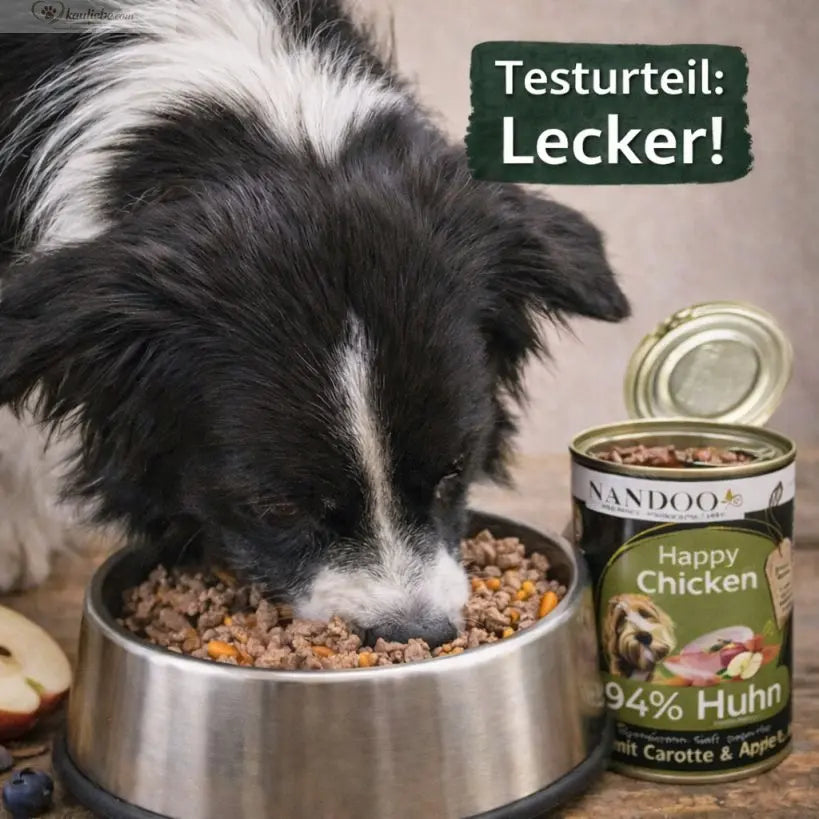
Happy Beef, Happy Chicken, Happy Deer and other varieties, all with green-lipped mussel for joint health, particularly relevant for seniors. Available in 400 g and 800 g tins as well as a mixed pack.
- → All NANDOO wet food varieties
- → Happy Beef, beef with carrot, pear & green-lipped mussel
- → Happy Deer, venison with carrot, apple & green-lipped mussel
- → Wet food for allergy sufferers, single-protein varieties
- → Wet food mixed packs, all varieties to try
Still not sure which variety is right?
Answer 4 short questions about your dog, and the food finder will recommend the right NANDOO variety for adults or seniors directly.
Find food now → For adult dogs · For seniors · For allergy sufferersFAQ: common questions about feeding adult and older dogs
From what age is my dog considered a senior?
This depends on the breed. Small breeds from around 10 to 12 years, medium breeds from around 8 to 9 years, large breeds from around 7 years, giant breeds from around 5 to 6 years. The switch to senior food should happen preventively, not only once problems become visible.
Does a senior really need less protein?
No, for healthy seniors without kidney disease, current veterinary guidelines (including WSAVA) don't recommend a reduced protein content. On the contrary: higher protein helps counteract muscle loss (sarcopenia). What should be reduced is total energy, through less fat and carbohydrates, not less protein.
My dog is neutered, do I need to adjust the portion size?
Yes. Due to the changed hormone balance, neutered dogs have an energy requirement around 20 to 30% lower than intact dogs. Many dogs gain weight after neutering because the portion size wasn't adjusted. Reduce the amount gradually after neutering and monitor the weight.
What should I do if my dog has an allergic reaction to beef or chicken?
First, confirm the diagnosis: a vet-supervised elimination diet (8 to 12 weeks, only one new protein source) is the gold standard. Then switch to a rare protein source, horse, lamb or pork as single-protein dry food or venison as wet food are proven alternatives. Treats and chews must also be restricted to this one protein source.
How often should I change my adult dog's food?
There's no need to change food regularly if your dog tolerates it well and is healthy. Constant switching puts strain on the gut and prevents stable assessment. If you switch for the sake of variety: transition slowly, use the same protein source where possible, and stay on the new food for at least 4 weeks before judging it.
Is wet food better for seniors than dry food?
Not fundamentally, but for seniors with dental problems, reduced appetite or who generally drink little, wet food can have advantages: easier to eat, higher moisture content, often better accepted. A combination of dry and wet food is a good middle ground for many seniors.
My senior is suddenly eating less, what should I do?
A short-term (1 to 2 days) reduction in appetite can be normal. If a senior permanently eats less, loses weight or seems lethargic as well, that's a signal for the vet, not a food matter. From around 7 to 8 years, an annual senior check-up is recommended even without acute symptoms.
Matching products at kauliebe
You'll find the right food in our dry food, specifically for older dogs in our dry food for seniors, as well as in our wet food.
The right food for seniors
Older dogs need easily digestible food with an adjusted energy content. Our senior varieties are tailored to this, grain-free and gently formulated.




