
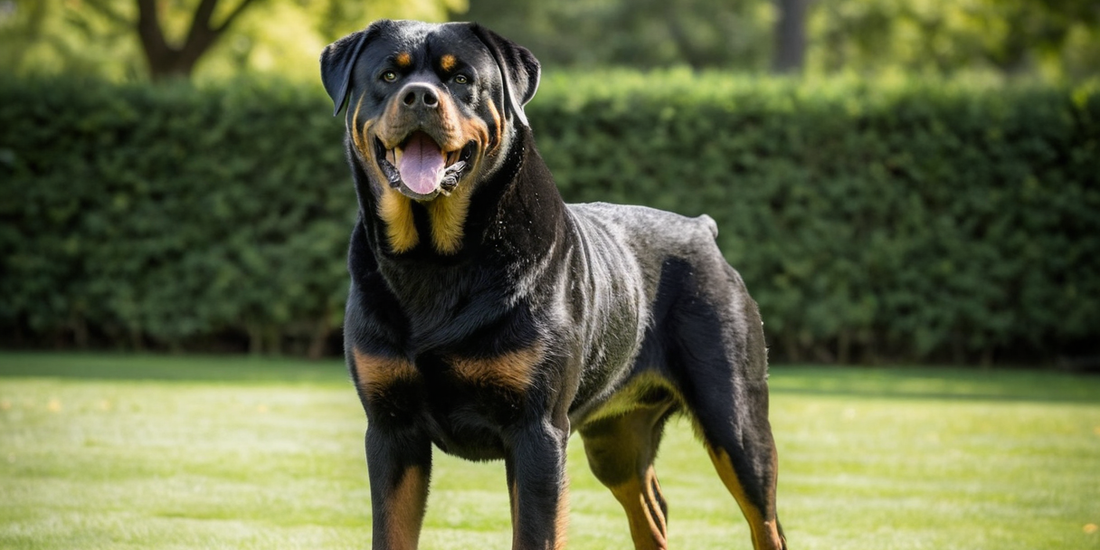
Rottweiler nutrition largely determines whether your dog can carry his muscular powerhouse frame healthily throughout his life. Hardly any other breed combines so much substance with so much calm: the Rottweiler is massive, powerful and yet remarkably composed. This exact combination places special demands on his food, his chew snacks and his weight management. Anyone who understands what's inside this dog automatically feeds him right.
The Rottweiler in profile: a powerhouse with high protein needs
The Rottweiler is one of the large, heavy dog breeds with pronounced musculature and a deep, broad chest. Males easily reach 50 kilograms, with females only slightly lighter. Despite his imposing appearance, the Rottweiler is naturally a calm, self-assured dog, not a constant runner and not a fidgety type. He moves deliberately but works with enormous strength and stamina when called upon.
For Rottweiler nutrition, this means two things: the musculature needs high-quality protein to be maintained and built up. At the same time, a calm Rottweiler burns noticeably fewer calories in everyday life than his athletic build might suggest. Food for the Rottweiler therefore needs to be protein-rich without automatically fattening the dog up. This balance is the common thread running through this breed's entire feeding regime.
The right food: protein for muscle maintenance
A Rottweiler is quite literally a mountain of muscle. This musculature is made of protein and is also maintained with protein. Rottweiler food should therefore provide a high proportion of high-quality animal protein, ideally from a single, clearly identifiable meat source. Single-protein recipes have a double advantage here: they provide concentrated protein and are also easy to digest, because the body doesn't have to cope with a mix of many different protein sources.
Make sure the food isn't padded out with cheap fillers. The higher the quality of the protein source, the less food your Rottweiler needs to feel full and well nourished, which in turn has a positive effect on his weight. Our food finder helps you filter out exactly the variety from our range that matches your Rottweiler's weight, activity level and any sensitivities.
Why grain-free makes sense for this breed
Grain mainly provides carbohydrates and little of what a muscular dog actually needs. Grain-free food instead frees up room in the bowl for high-quality protein and easily digestible carbohydrate sources such as potato or sweet potato. For the Rottweiler, whose muscle mass constantly needs supplying, this is a clear advantage. Grain-free recipes are also often better tolerated, which is an additional plus for a breed with an occasionally sensitive stomach.
Both dry food and wet food suit the Rottweiler; what matters most is the quality of the ingredients. Some owners combine both: dry food as the base, wet food as a tasty addition or for dogs that need more fluid.
Weight & joints: the calm powerhouse
This is exactly where the biggest feeding trap lies with the Rottweiler. His calm, relaxed nature easily tempts owners to spoil him: more treats, bigger portions, less exercise than with a lively dog. The problem: being overweight has particularly serious consequences for such a heavy breed. Every extra kilogram puts additional strain on the hips, elbows and heart of a dog that already carries a lot of weight on his joints.
Rottweiler joints in particular deserve special attention for this reason. A healthy body weight is the most effective measure for protecting hips and elbows in the long term, more effective than any supplement. Regularly check your dog's ribs: you should be able to feel them with light pressure but not see them. It's better to adjust the amount of food frequently in small steps rather than making big jumps. It's also worth keeping a close eye on treat consumption, precisely because the Rottweiler's calm nature rarely signals "stop" on its own.
Sufficient but joint-friendly exercise is also part of nutrition in the broader sense: long, calm walks instead of excessive jumping or abrupt stop-and-go movements, especially for young and older animals.
Robust chew snacks for a strong bite
What does a Rottweiler particularly like to eat away from the bowl? Anything that's really satisfying to chew. No wonder: the Rottweiler has one of the most powerful bites among dog breeds. Soft, quickly crushed snacks are often history within seconds for him and offer his jaw hardly any real occupation. Rottweiler chew snacks therefore need to hold up to a lot.
Particularly long-lasting, natural chews suit this exact need. The beef Achilles tendon is a tough, sinewy chew that keeps the Rottweiler occupied for a long time and comes entirely without additives. Even more robust are buffalo strossen: single-sourced, air-dried and naturally resistant enough to withstand even powerful chewers. Buffalo skin too, whether as a giant braid, in natural form or as a roll, is a real favourite for many Rottweilers and holds up to the massive bite without shattering within seconds.
In our chew snack collection and especially among the buffalo chew snacks you'll find a wide selection of exactly these resilient varieties. All are single-sourced and grain-free, so your Rottweiler gets only high-quality, natural ingredients even while chewing. If you're unsure which variety matches your dog's chewing intensity, our chew finder can help you choose.
A tip from practice: robust chew snacks aren't just occupation for the Rottweiler, they're also active dental care. Regular, thorough chewing supports the natural cleaning of the teeth and can help prevent tartar, a pleasant side effect of a chewing session he loves anyway.
Allergies & sensitive digestion
Even though the Rottweiler isn't considered a particularly allergy-prone breed, individual dogs can react sensitively to certain food components. Typical signs are recurring skin problems, itching, soft stools or frequent vomiting. Before randomly trying out different food varieties, a structured approach pays off: an elimination diet with single-protein, grain-free food helps to identify possible triggers specifically, by feeding only a single, new protein source for a few weeks and observing how your dog reacts.
Single-protein recipes are ideal for exactly these situations, since they contain no unnecessary additives and no hidden mixtures. You'll find a step-by-step guide on our page about the elimination diet. Important: if symptoms persist, always carry out the dietary change together with your veterinary practice.
The Rottweiler puppy: controlled growth
With large breeds like the Rottweiler, healthy joint development doesn't start in adulthood but already in the first months of life. Rottweiler puppies grow enormously fast, gaining several kilograms in a short time. This rapid growth carries a risk: if the puppy grows too fast or is fed too generously, the strain on bones and joints that aren't yet fully mature increases significantly. In the long run, this can negatively affect hip and elbow development.
Controlled, slow growth is therefore the best protection for your young Rottweiler's joints. What matters is puppy food tailored to large breeds with a balanced calcium-to-phosphorus ratio, moderate rather than generous food amounts, and regular weight checks. During this phase, also avoid excessive extra calories from treats, however tempting those loyal Rottweiler eyes may be. The same applies to puppies: better slim through the growth phase than prematurely "finished" feeding.
Frequently asked questions about Rottweiler nutrition
How much protein does a Rottweiler really need?
As a muscular, large breed, the Rottweiler benefits from food with a high proportion of high-quality animal protein from a clearly defined source. The exact amount depends on activity, age and weight, which is why an individually suited food makes more sense than a blanket figure.
Is the Rottweiler prone to being overweight?
Yes, due to his calm nature and size, the Rottweiler is more prone to being overweight than more active breeds. Regular weight checks, adjusted portions and moderate exercise are important building blocks for relieving the joints, hips and heart in the long term.
Which chew snacks suit his powerful bite?
Particularly robust, single-sourced chews such as beef Achilles tendon, buffalo strossen or buffalo skin stand up to the strong chewer while offering long, healthy occupation without unnecessary additives.
What to do about digestive problems or skin irritation?
If your Rottweiler reacts with itching, soft stools or vomiting, a structured elimination diet with single-protein, grain-free food can help narrow down the trigger. If symptoms persist, it's advisable to get support from a veterinary practice.
Character & who the Rottweiler suits
In short, the Rottweiler suits best: experienced, confident owners, watchdog/guard.
- Size: large
- Energy level: medium
- With children: very good with children
- Apartment living: rather unsuitable for apartments
- For beginners: better suited to experienced owners
- Coat care: medium grooming effort
- Trainability: eager to learn
- Alertness: pronounced watchdog
Not sure whether this breed fits your life? Find out with our breed finder "Which dog breed suits me?"
Goes well with: Natural treats for dogs





